

Instrument Rating
Fly Beyond Visual Conditions
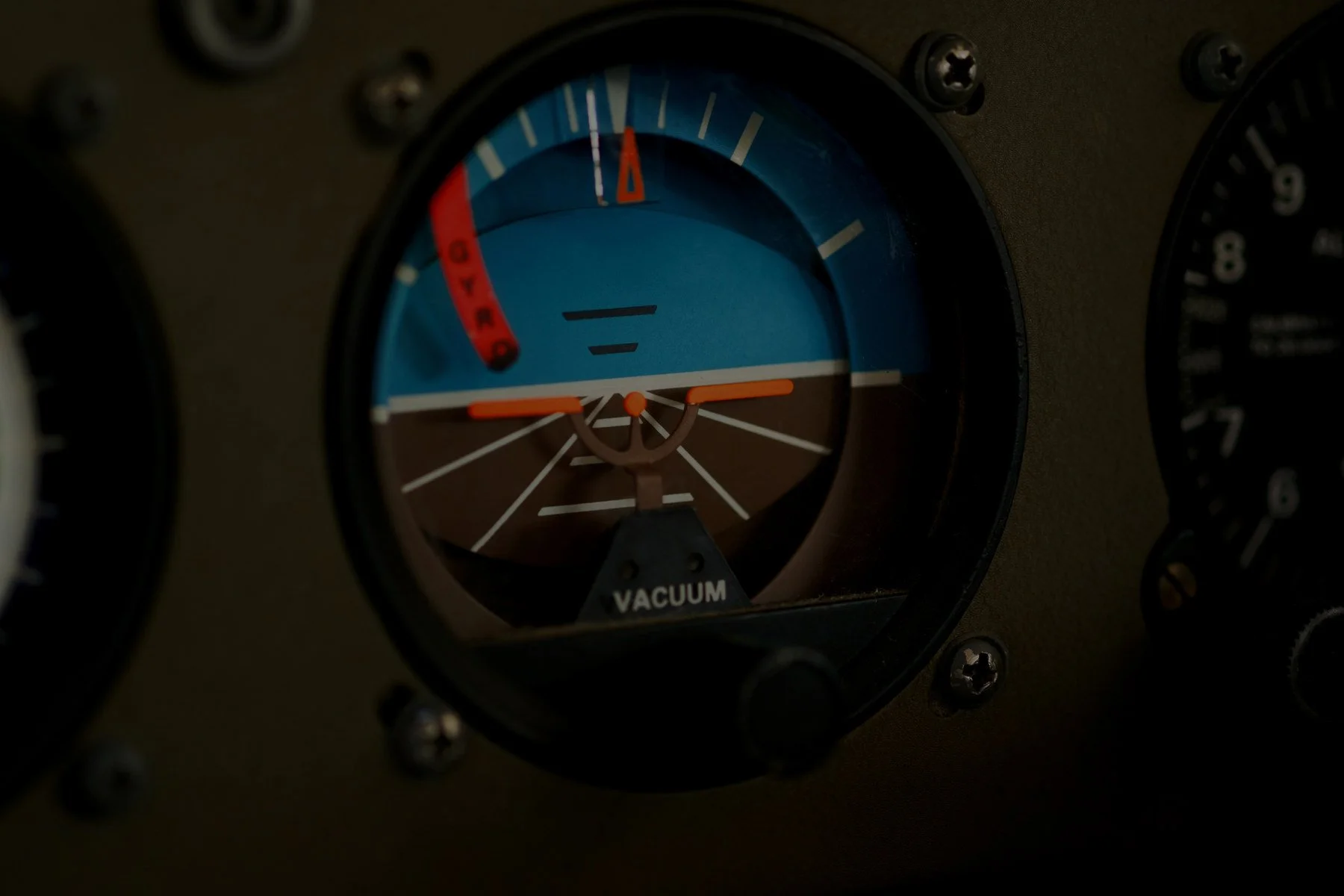
The Instrument Rating (IR) allows you to fly in clouds, low visibility, and instrument meteorological (IMC) conditions. It's the most important rating a Visual Flight Rules (VFR) pilot can add, and a requirement for any serious aviation career.
PREREQUISTE
Private Pilot
Certificate required
WITH INSTRUCTOR
15 hours min
Of instrument time
TRAINING PATHS
Part 61 & Part 141
Both available at Bravo
MIN INSTRUMENT TIME
Actual or
simulated IMC
What Training Looks Like
Instrument training follows a structured progression from basic attitude flying to real-world IFR operations.
Here’s what to expect at each phase.
INSTRUMENT FUNDAMENTALS
Transition to flying solely by reference to instruments. You’ll develop a disciplined scan, control pitch and bank without outside references, and build the mental habits that instrument flying demands.
NAVIGATION & PROCEDURES
Master VOR, GPS, and ILS navigation. You’ll learn to read approach plates, track airways, and fly standard instrument departures and arrivals, the vocabulary of IFR flight.
APPROACH PROCEDURES
Fly precision and non-precision approaches — ILS, LOC, VOR, and GPS — from the initial approach fix down to minimums. You’ll learn how to brief an approach, when to continue, and when to execute the missed approach procedure.
IFR CROSS-COUNTRY
Plan and fly IFR routes using real-world ATC, weather briefings, and en route procedures. You’ll file flight plans, pick up clearances, and manage the workload of actual IFR operations.
HOLDS & UNUSUAL ATTITUDES
Holding procedures, procedure turns, and recovery from unusual attitudes are the test of your instrument scan. You’ll practice until the responses are automatic.
CHECKRIDE PREP & PRACTICAL TEST
A thorough oral covering weather, regulations, and IFR systems, followed by a full mock checkride flight. When you sit with the examiner, there are no surprises.
FAA REQUIREMENTS
WHAT YOU’LL NEED
These requirements must be met by the time of your checkride, not before you start training.
We’ll guide you through each one.
PRIVATE PILOT CERTIFICATE
Must hold at least a Private Pilot Certificate (or be concurrently enrolled in a combined program).
MEDICAL CERTIFICATE
Must hold at least a Third Class Medical Certificate (Second Class required for commercial privileges).
INSTRUMENT TIME
Minimum 40 hours of actual or simulated instrument time. At least 15 of those hours must be with an authorized instructor. Of those, at least 3 hours must be completed within 2 calendar months of your practical test.
KNOWLEDGE TEST
Must pass the FAA Instrument Rating Knowledge Test with a score of 70% or higher.
CROSS-COUNTRY PIC TIME
Minimum 50 hours of cross-country flight time as Pilot in Command.
HOURLY REQUIREMENTS
PART 61 vs. PART 141
PART 61
50 hours cross-country flight time as Pilot in Command
40 hours actual or simulated instrument time
15 hours of instrument time with an authorized CFII
3 hours of instrument training within 2 calendar months of the checkride
250 nm cross-country flight with an instrument approach at each airport
Three different kinds of approaches using navigation systems
PART 141
No cross-country Plot In Command hour requirement
35 hours of instrument flight training
15 hours of instrument time with an authorized CFII
3 hours of instrument training within 2 calendar months of the checkride
250 nm cross-country flight with an instrument approach at each airport
Three different kinds of approaches using navigation systems
Your Questions, Our Answers
-
Most pilots complete their instrument training in 2-4 months when training consistently. The FAA requires a minimum of 40 hours of actual or simulated instrument time, but the average is around 50-60 hours total.
-
Yes, you must hold at least a Private Pilot Certificate before earning your Instrument Rating. However, you can begin instrument training while building your private pilot experience.
-
Description text goes here
-
Item description
-
To exercise IFR privileges, you must complete six instrument approaches, holding procedures, and intercepting/tracking courses within the preceding six months. An Instrument Proficiency Check (IPC) is required if you lapse.
-
Yes, an Instrument Rating is required for most aviation careers. It’s a prerequisite for the Commercial Pilot Certificate and essential for airline, corporate, and charter flying.
WHERE WE ARE
Our Locations
We operate out of two airports in the Mid-Atlantic region.
Frederick Municipal Airport - KFDK
330 Aviation Way C, Frederick, MD 21701
Eastern West Virginia Regional Airport - KMRB
214 Aviation Way, Martinsburg, WV 25405
Ready to Get Started?
There’s no better time to begin than right now. Take the next step, and we’ll walk you through everything and have you in the air before you know it.